
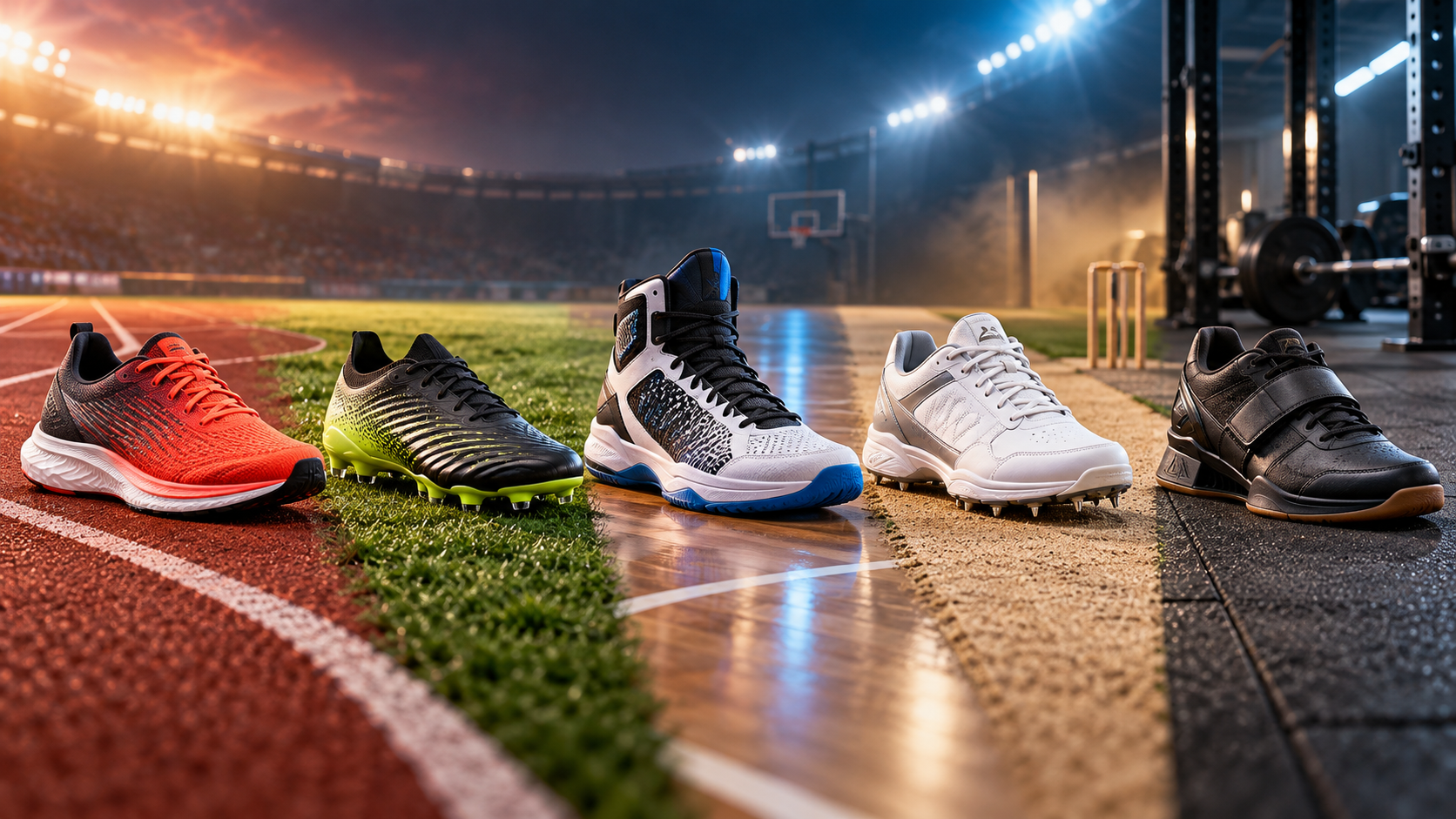
Athletes spend hours improving strength, speed, balance, and technique, yet every movement still passes through one small point of contact: the shoe. Whether someone is sprinting on a track, cutting across a basketball court, bowling in cricket, or lifting a barbell, the wrong footwear can make the activity less comfortable and less controlled.
The role of footwear in sport goes far beyond appearance. A well-chosen shoe helps the foot interact with the ground, supports the movements demanded by the activity, and provides suitable grip, cushioning, or stiffness. The right design may improve comfort and performance, while a poor fit or a mismatched outsole can contribute to blisters, pressure points, slipping, and unwanted stress.
No shoe can prevent every injury or replace proper training. However, understanding sports footwear makes it much easier to choose a pair that works with the athlete, the surface, and the demands of the game.
Why Is Footwear Important in Sport?
Different sports place very different loads on the feet and lower limbs. A distance runner repeats a mostly forward motion thousands of times. A tennis player accelerates, stops, and changes direction laterally. A footballer needs enough traction to sprint and cut on grass without the studs locking the foot too firmly into the surface.
Good athletic footwear is designed around those demands. Its job may include:
- Creating grip between the athlete and the playing surface
- Cushioning repeated impact
- Providing a stable platform during changes of direction
- Protecting the foot from rough ground or contact
- Supporting efficient force transfer
- Keeping the foot secure inside the shoe
- Reducing rubbing, pressure, and unwanted movement
- Helping the athlete feel confident during sport-specific actions
These functions must be balanced. A highly cushioned shoe may feel comfortable for a long run but unstable during heavy squats. A football boot with aggressive studs may grip soft natural grass well but create excessive traction on artificial turf. The “best” shoe therefore depends on what the athlete is doing and where they are doing it.
How Sports Shoes Affect Performance
Footwear sits between the body and the ground, so even small design changes can influence movement. Weight, sole stiffness, traction, cushioning, and geometry can affect how an athlete accelerates, lands, turns, and transfers force.
Traction
Traction allows an athlete to push against the surface without slipping. It matters in field sports, court sports, running, hiking, and almost any activity involving rapid movement. Too little grip wastes force and reduces control. Too much rotational grip can also be a problem because the shoe may remain fixed while the leg turns above it.
This is why stud and tread patterns are specific to the surface. Firm-ground football boots, artificial-grass boots, indoor shoes, and soft-ground studs are not interchangeable simply because they are used for the same sport.
Cushioning and impact management
The midsole compresses when the foot lands and helps manage impact. Running and jumping shoes often use foam to create a softer landing and a smoother transition into the next step. More cushioning is not automatically better, however. Excessively soft or tall foam may feel unstable for an athlete who needs a firm base or strong awareness of the ground.
Stability
Stability comes from the shape of the platform, the firmness of the sole, the heel structure, the upper, and the way the shoe holds the foot. Court shoes often have a wider base and stronger lateral support because the athlete repeatedly moves from side to side. Weightlifting shoes use a firm platform because compression under a heavy load can reduce stability.
Energy transfer
Some shoes are designed to waste as little energy as possible. Stiff cycling soles transfer force into the pedal, sprint spikes create a rigid platform under the forefoot, and weightlifting shoes provide a solid base against the floor.
Modern carbon-plated running shoes combine stiffening elements, high-rebound foam, and curved sole geometry. Systematic reviews indicate that advanced footwear technology can improve running economy and endurance performance on average, although the benefit varies between runners.
Confidence and comfort
Comfort is not a minor detail. A shoe that pinches, slips, or feels unpredictable can distract an athlete and alter movement. Research on running footwear increasingly treats personal comfort as a useful part of shoe selection, rather than assuming that one universal design suits every foot.
Main Parts of a Sports Shoe
Understanding basic shoe construction helps shoppers compare function instead of being distracted by colorways and advertising.
| Shoe component | What it does | What to check |
|---|---|---|
| Upper | Wraps and secures the foot | Breathability, durability, flexibility, and pressure-free fit |
| Toe box | Gives the toes room to spread and move | Adequate width and depth without excessive sliding |
| Heel counter | Adds structure around the rearfoot | Secure heel hold without rubbing the Achilles area |
| Midsole | Provides cushioning, stiffness, and ride characteristics | Appropriate firmness and thickness for the activity |
| Outsole | Contacts the ground | Tread, rubber durability, studs, spikes, and surface compatibility |
| Insole or sockliner | Creates the surface directly beneath the foot | Comfort, moisture management, and space for an orthotic if required |
| Heel-to-toe drop | Describes the height difference between heel and forefoot | Familiarity, comfort, and a gradual transition when changing geometry |
| Closure system | Holds the foot inside the shoe | Even pressure from laces, straps, dials, or other secure fasteners |
| Plate or shank | Adds stiffness or controls flex | Whether the stiffness suits running, cycling, lifting, or another movement |
A feature can be helpful in one context and unhelpful in another. A stiff sole is useful for cycling but awkward for running. Deep lugs grip loose trails but feel unstable on a smooth gym floor.
Types of Footwear Used in Different Sports
Running shoes
Running shoes are designed for repeated forward movement. They normally combine forefoot flexibility, cushioning, a secure heel, and an outsole suited to road, track, or trail surfaces.
Daily trainers prioritize durability and comfort. Lightweight tempo shoes feel faster but may use less durable material. Racing shoes focus on low weight and energy return, while trail-running shoes add deeper lugs, tougher uppers, and sometimes a protective rock plate.
Runners should not assume that a shoe labeled “neutral,” “stability,” or “maximum cushioning” is automatically correct for them. Fit, comfort, training history, pace, surface, and previous injuries all matter. A sudden move to a much lower drop, minimalist design, or very stiff plate can shift load to unfamiliar tissues and should be introduced gradually.
Football and soccer boots
Football boots use studs or molded projections to create grip. The correct outsole depends on the pitch:
- Firm-ground designs suit many dry natural-grass fields
- Soft-ground boots use longer studs for wet or muddy grass
- Artificial-grass boots spread pressure through shorter, more numerous studs
- Turf shoes use small rubber projections for shallow synthetic surfaces
- Indoor football shoes use a flat rubber outsole
The match between the boot and the surface is critical. Excessive shoe-surface traction can restrict rotation during a cut or turn, while insufficient grip can lead to slipping. Players should follow facility rules because some pitches ban metal or certain aggressive stud patterns.
Basketball shoes
Basketball involves sprinting, jumping, landing, and rapid lateral cuts. Basketball shoes normally use a wide platform, durable court rubber, lateral containment, and impact cushioning.
High-top collars can change the feeling of ankle support, but height alone does not guarantee protection from sprains. Evidence on high-top versus low-top shoes is mixed, and factors such as previous injury, strength, balance, bracing, fit, and landing mechanics also matter. The best basketball shoe should hold the foot securely without restricting natural movement or creating pressure around the ankle.
Tennis, badminton, squash, and volleyball shoes
These court shoes are built for stops, starts, and side-to-side movement. They usually have stronger lateral support and more durable outsoles than ordinary running shoes. Tennis models may also vary by court type: hard-court shoes emphasize durability, clay shoes use tread that releases surface material, and grass shoes require controlled grip.
Indoor-court shoes should use non-marking rubber where the facility requires it. The outsole must be clean and in good condition; dust and worn tread can significantly reduce grip.
Cricket shoes
Cricket places different demands on batters, fast bowlers, spin bowlers, fielders, and wicketkeepers. Cricket shoes may use full spikes, partial spikes, or rubber outsoles depending on the role and surface.
Fast bowlers generally need secure heel hold, forefoot stability, and an upper that controls movement during the delivery stride. Batters and fielders often prioritize a lighter feel, flexible forefoot, and reliable grip for short sprints and sudden turns. On hard practice surfaces or artificial wickets, rubber-studded shoes are usually more appropriate than metal spikes.
Track and field footwear
Track spikes are highly specialized. Sprint spikes use a rigid forefoot plate to support powerful acceleration, while distance spikes usually allow more flexibility and cushioning. Jumping and throwing shoes are designed around the rotational, blocking, or take-off demands of each event.
Competitive athletes must also check governing-body rules. World Athletics maintains an approved-shoe system and regulates features such as sole thickness for ranked competitions. A shoe sold as a racing model is not automatically legal for every event.
Weightlifting and strength-training shoes
Heavy lifting requires a stable base. Weightlifting shoes normally use a firm, minimally compressible sole and a secure strap or lacing system. Many models have an elevated heel, which can help some lifters maintain a more upright position during squats and Olympic lifts.
Soft running shoes are poorly suited to maximal lifting because their foam compresses and shifts under load. For general gym training, a flat, stable cross-training shoe may be more versatile than a dedicated lifting shoe.
Cycling shoes
Cycling shoes use stiff soles to transfer force efficiently into the pedal. Road models prioritize low weight and stiffness, while mountain-bike shoes add tread for walking and off-bike grip. Cleat position and pedal compatibility must be set correctly; persistent knee or foot discomfort may require a professional bike fit.
Golf shoes
Golf footwear balances traction during the swing with comfort over several hours of walking. Spiked models provide strong grip on soft ground, while spikeless shoes are more versatile on firm courses and indoor areas. Waterproofing, fit, and outsole flexibility are often as important as the traction system.
Cross-training shoes
Cross-training shoes combine features for gym classes, short runs, agility work, and moderate strength training. They typically have a broader, firmer platform than a running shoe but more forefoot flexibility than a dedicated weightlifting shoe.
They are useful for varied workouts, but compromise has limits. Someone who runs long distances or plays one sport several times per week will usually benefit from footwear designed specifically for that activity.
Footwear and Sports Injury Prevention
Shoes can influence how forces move through the body, but injuries rarely have one cause. Training load, previous injury, strength, recovery, technique, playing surface, sleep, and anatomy can all contribute.
This matters because injury prevention footwear is often marketed with promises the evidence cannot fully support. A stability feature, high collar, soft midsole, or custom insert may be useful for a particular athlete, yet no feature can guarantee that the person will remain injury-free.
The strongest practical principles are simpler:
- Wear a shoe made for the movement and surface
- Choose a comfortable fit from the beginning
- Replace footwear after grip or structure has noticeably deteriorated
- Introduce major changes in cushioning, drop, stiffness, or minimalist design gradually
- Address persistent pain instead of trying to solve every problem by buying another shoe
- Combine suitable footwear with progressive training, strength, and recovery
For field sports, stud-surface compatibility deserves special attention. Research links very high shoe-surface interaction with greater lower-limb injury risk in football codes. The goal is useful traction—not the maximum possible grip.
How to Choose the Right Sports Shoes
Start with the activity and surface
Decide exactly how the shoe will be used. Road running, artificial turf, indoor court, trail, grass, track, and gym flooring demand different outsoles. A shoe bought for one surface may perform poorly or wear quickly on another.
Measure both feet
Feet can change in size and shape over time, and one foot is often slightly larger. Fit the shoe to the larger foot and treat the printed size as a starting point, not a guarantee. Different brands and models can fit differently even when the label shows the same number.
Try shoes when the feet are not at their smallest
Feet often expand during the day and with exercise. Trying shoes later in the day or after light activity can give a more realistic fit. Wear the socks, braces, or orthotics that will be used during the sport.
Check the toe box
The toes should move freely without being squeezed together. A common fitting guide is roughly a finger’s width between the longest toe and the front of the shoe, though high-speed boots and specialized footwear may use a closer performance fit. Width and depth matter as much as length.
Secure the heel and midfoot
The heel should feel held rather than sliding with each step. The midfoot should be secure without numbness or excessive pressure from the laces. A runner or field athlete needs enough hold to stop the foot moving inside the shoe during turns and descents.
Test sport-specific movements
Walking around a shop is not enough for every sport. When space and store rules allow, perform a gentle jog, lateral shuffle, controlled lunge, or squat. Check for heel lift, toe impact, instability, hot spots, and pressure along the sides of the foot.
Do not depend on a break-in period
Minor material softening is normal, but a shoe that pinches or rubs in the shop is unlikely to become the right shape later. Comfort should be present from the first wear.
Consider specialist advice when needed
A knowledgeable sports retailer can help compare sizes and designs. Athletes with persistent pain, recurring injuries, significant foot deformity, diabetes-related foot concerns, or complex orthotic needs should consult an appropriately qualified healthcare professional.
Common Mistakes When Buying Sports Footwear
Choosing by appearance alone
Color and style matter to many athletes, but they should come after fit, function, and surface suitability. A fashionable shoe that causes heel slip or toe pressure is still a poor choice.
Using running shoes for every sport
Running shoes are built mainly for forward motion. They may lack the lateral stability required for tennis, basketball, or fast gym classes. Their soft foam can also be unstable during heavy lifting.
Buying shoes that are too small
A close performance fit should not mean crushed toes, numbness, or nails striking the front of the shoe. Feet can swell during long sessions, so a pair that barely fits when cool may become painful during play.
Assuming more cushioning always means more protection
Cushioning changes comfort and impact management, but injury risk is more complex. Athletes respond differently to foam softness, stack height, stiffness, and geometry.
Copying a professional athlete’s shoe
Elite athletes may wear customized versions, choose shoes for short competition periods, or have very different biomechanics. The model that works for a professional is not automatically suitable for a recreational player.
Ignoring the playing surface
Using soft-ground studs on a hard field, firm-ground boots on some artificial pitches, or deep trail lugs on a smooth floor can reduce control or create excessive stress.
Changing footwear too quickly
Moving suddenly from a conventional trainer to minimalist footwear, a radically different heel drop, or a stiff plated shoe changes the load on the foot and lower leg. Introduce unfamiliar designs through shorter sessions before using them for full training volume.
Modern Technology in Sports Footwear
Sports-shoe development now combines biomechanics, materials science, athlete testing, and digital manufacturing.
High-rebound foams
Modern foams aim to reduce weight while returning more energy after compression. The effect depends on the entire shoe, not the foam name alone. Geometry, stiffness, athlete speed, and individual movement patterns all shape the result.
Carbon and composite plates
Plates can increase longitudinal stiffness and work with curved soles and resilient midsoles. They are most visible in endurance racing shoes, but stiffening elements also appear in sprint spikes, court footwear, and cycling shoes.
3D printing and personalized components
Digital design allows manufacturers to create complex midsoles, uppers, and structures that would be difficult to mold conventionally. Foot scanning and pressure data may support more individualized designs, although consumer scanning tools vary in accuracy.
Smart footwear
Sensors can estimate pace, pressure, contact time, and movement patterns. These features may help research and coaching, but the data should be interpreted carefully. A shoe sensor cannot diagnose an injury or replace professional assessment.
Competition regulation
Technology can become so influential that governing bodies set limits. World Athletics publishes shoe regulations and an approved-model database for ranked competitions. Serious competitors should verify a model before race day instead of relying only on a retailer’s description.
When Should Sports Shoes Be Replaced?
There is no exact replacement date for every athlete. Body mass, gait, surface, weather, shoe design, and training volume all affect wear.
For running shoes, 300 to 500 miles is often used as a rough range, and around 300 hours of exercise is another general reference for athletic footwear. These figures are only guides. Inspect the shoe itself and pay attention to changes in feel.
Signs that replacement may be due include:
- The outsole is smooth in important grip areas
- Studs, spikes, or lugs are worn, damaged, or uneven
- The midsole feels flat or noticeably different from the other shoe
- The shoe leans to one side on a level surface
- The heel counter has collapsed
- The upper no longer holds the foot securely
- New rubbing, discomfort, or slipping appears without another clear cause
- The sole separates or the internal structure becomes exposed
Do not wait for a shoe to look destroyed. Performance can decline before the upper develops a hole.
How to Care for Athletic Footwear
Remove mud and debris soon after use, especially from studs and tread. Let wet shoes dry naturally in a ventilated area; strong direct heat can damage adhesives, foam, and upper materials. Taking out the insoles can speed drying.
Avoid leaving sports shoes in a hot vehicle for long periods. Loosen the laces before taking them off instead of crushing the heel. If training frequently, rotating between pairs allows moisture to dry and makes it easier to notice when one shoe has lost its original feel.
Use each pair on its intended surface whenever possible. Wearing running shoes as everyday footwear adds mileage, while walking on concrete in track spikes or soft-ground studs can damage both the shoe and the floor.
When Foot or Ankle Pain Needs Professional Attention
Stop and seek qualified advice when pain is severe, follows a sudden injury, causes limping, or comes with significant swelling, bruising, numbness, weakness, or inability to bear weight. Persistent pain that returns during sport also deserves assessment.
Shoes may be part of the solution, but repeated symptoms can involve training load, technique, strength, mobility, or an underlying condition. A sports-medicine clinician, physiotherapist, podiatrist, or foot-and-ankle specialist can assess the wider picture rather than treating footwear as the only factor.
