
The phrase itsy mya has attracted attention among word puzzle enthusiasts, particularly those exploring unusual answers in the New York Times Connections game. Although these words might initially appear unrelated, they share a clever linguistic connection.
In the May 24, 2026, NYT Connections puzzle, ITSY and MYA appeared in a challenging category that required players to recognize hidden grammatical patterns.
Understanding this wordplay can help puzzle lovers improve their solving skills and approach similar challenges confidently.
What Does Itsy Mya Mean?
The combination “itsy mya” does not have a widely established meaning as a standalone English phrase.
However, ITSY and MYA became connected through NYT Connections puzzle number 1078, published on May 24, 2026.
In this puzzle, both words belonged to the purple category, traditionally associated with more difficult word associations.
The challenge involved identifying possessive adjectives hidden within apparently unrelated words.
This unusual relationship made the puzzle particularly interesting for players who enjoy language-based challenges.
Itsy Mya NYT Connections Answer Explained
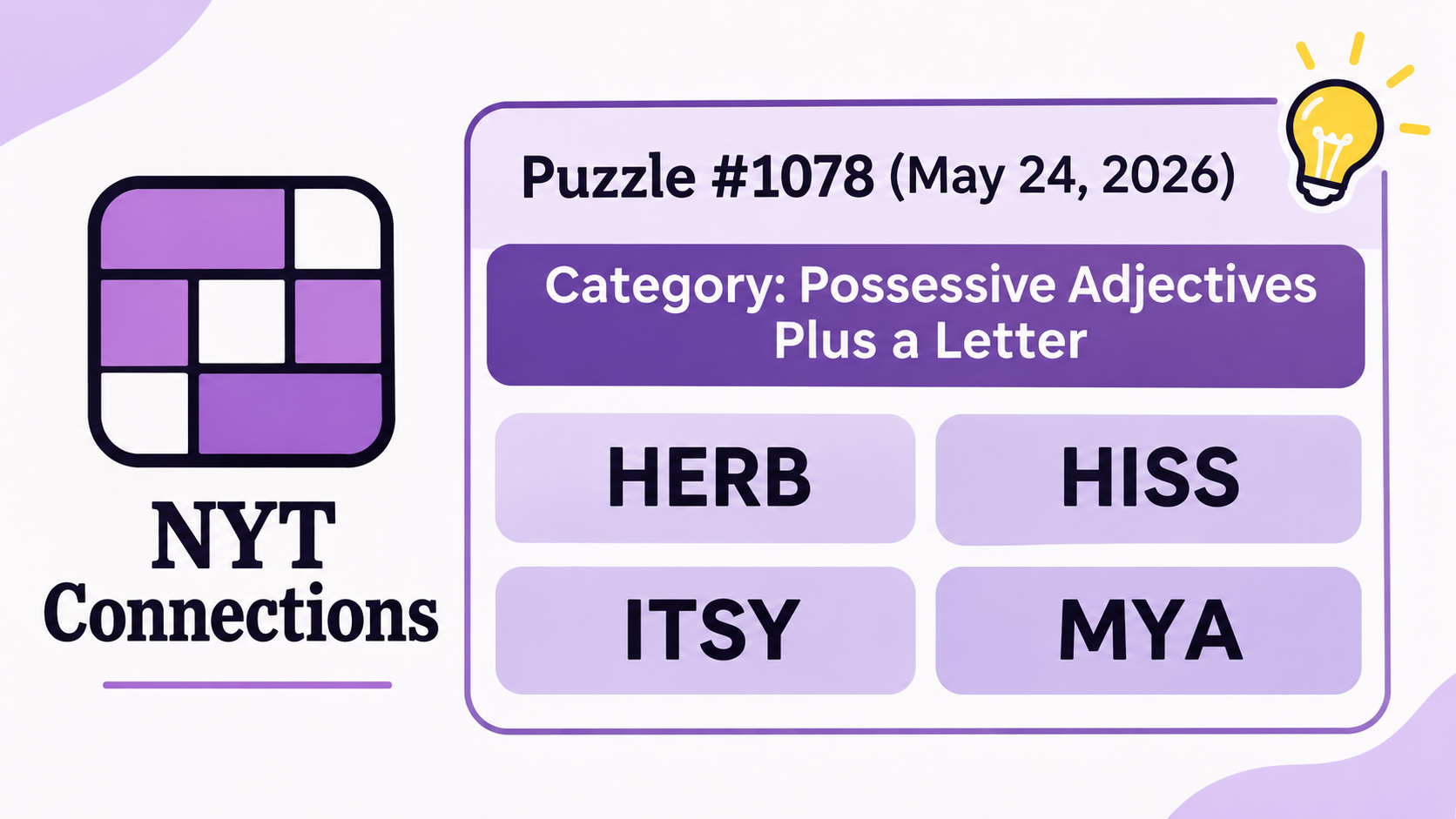
The purple category was called Possessive Adjectives Plus a Letter.
Its four answers were:
- HERB: HER + B
- HISS: HIS + S
- ITSY: ITS + Y
- MYA: MY + A
Each word contains a possessive adjective followed by one additional letter.
For example, ITSY begins with “its,” while MYA begins with “my.”
Although the resulting words have different meanings, their grammatical structures follow the same pattern.
Recognizing this hidden connection was the key to solving the category successfully.
Why Was the Itsy Mya Puzzle Difficult?
The main difficulty came from the misleading appearance of the words.
ITSY commonly reminds people of the familiar expression “itsy-bitsy,” meaning very small.
Meanwhile, MYA looks like a personal name rather than a traditional puzzle answer.
HERB suggests a plant, while HISS describes a sharp sound.
These everyday associations can distract players from recognizing the underlying grammatical relationship.
The puzzle therefore required lateral thinking rather than relying entirely on ordinary word definitions.
Other NYT Connections Answers From May 24, 2026
Besides the purple category, the puzzle contained three additional groups.
Yellow – Farm Fixtures: COOP, PEN, SHED, STABLE.
Green – Labor Protest Actions: MARCH, PICKET, RALLY, STRIKE.
Blue – Objects Used in Ritual Performances: DRUM, MASK, RATTLE, STAFF.
Purple – Possessive Adjectives Plus a Letter: HERB, HISS, ITSY, MYA.
These categories combined everyday vocabulary with more challenging language patterns.
Tips for Solving Similar Word Puzzles
Players can improve their performance by examining words from different perspectives.
Instead of focusing only on definitions, consider spelling patterns, word beginnings, hidden expressions, and grammatical structures.
Identifying straightforward categories first can also reduce confusion.
When only a few unfamiliar words remain, look for unexpected relationships between their letters.
Regular practice develops vocabulary recognition and strengthens problem-solving abilities.
Why Are Unusual Connections Answers Popular?
Unusual word combinations encourage curiosity because their relationships are not immediately obvious.
Players frequently search online for explanations after encountering unfamiliar patterns.
Challenges involving hidden words are especially memorable because the solution often becomes clear once the underlying rule is revealed.
The ITSY and MYA combination demonstrates how simple words can create surprisingly challenging puzzles.
Final Thoughts
The itsy mya connection demonstrates the creative wordplay featured in NYT Connections.
Both words appeared in the May 24, 2026, puzzle as part of a possessive-adjective category.
Understanding the relationship between ITSY, MYA, HERB, and HISS offers a useful lesson in recognizing hidden spelling patterns and approaching difficult word games.
