
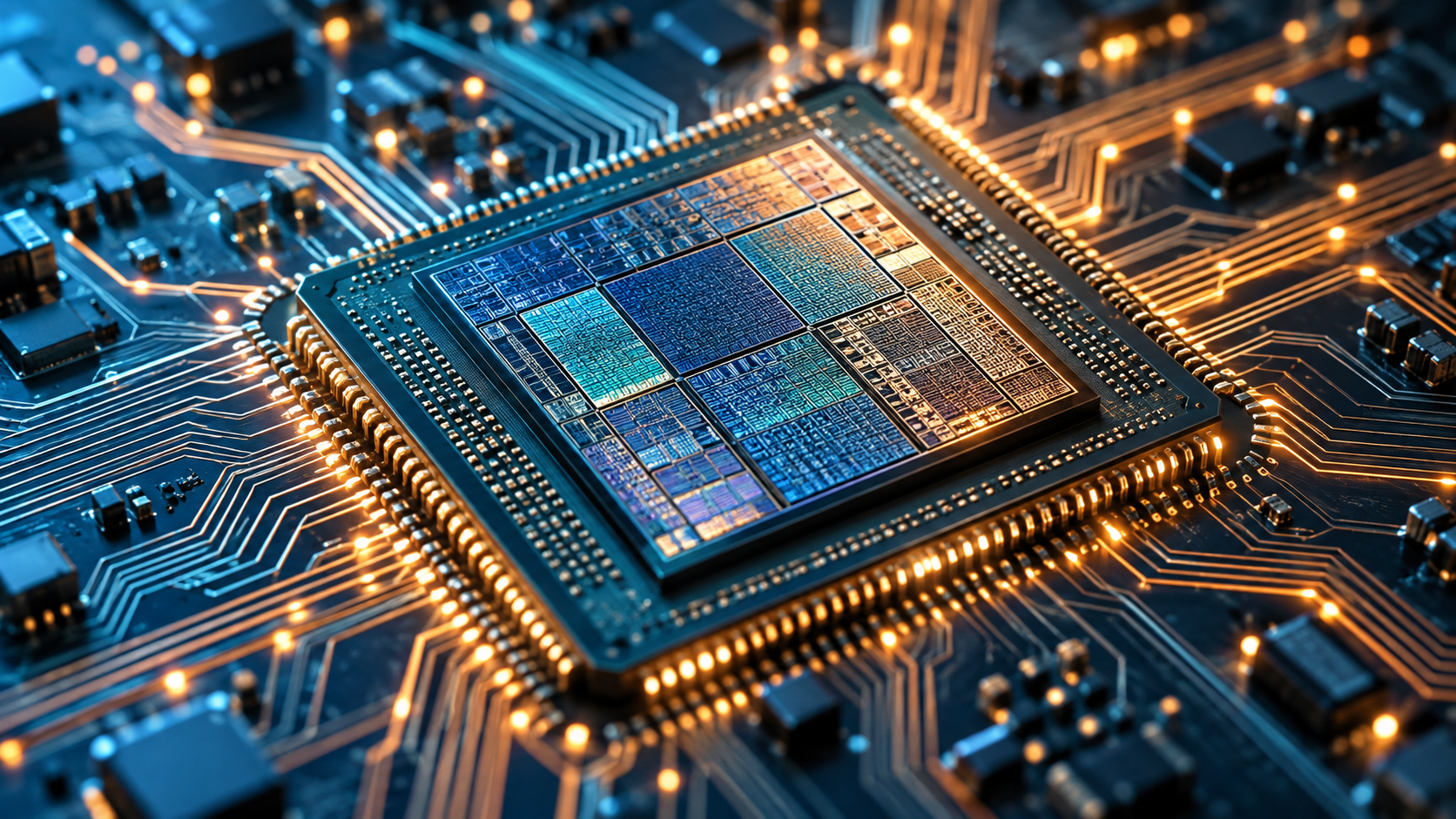
Moore’s Law is the observation that the number of transistors on an integrated circuit tends to increase rapidly over time, often described as doubling roughly every two years while keeping costs relatively low. It helps explain why computer chips became smaller and more capable across generations. Despite the name, it is a prediction about an industry trend, not a scientific law that guarantees what every future chip will do.
How Moore’s Law began
In 1965, engineer Gordon Moore published an article called “Cramming More Components onto Integrated Circuits.” He examined how the number of components on chips had grown and projected that the trend would continue. His original forecast looked ahead about ten years and suggested that component counts could keep rising substantially.
Moore later adjusted the pace of his prediction. The version most people know today is that transistor counts on chips double about every two years. The phrase “Moore’s Law” was coined by Carver Mead, not Moore himself. Intel describes the modern formulation as an observation about transistor growth with only a minimal increase in cost.
What is a transistor?
A transistor is a tiny electronic switch that helps a chip process and store information. Modern processors contain billions of them. If manufacturers can fit more transistors onto a chip, they can often build chips that handle more complex tasks or perform certain operations more efficiently.
Moore’s Law is specifically about the number of transistors that can be placed on an integrated circuit. It is not a promise that every computer will become twice as fast every two years. Overall performance also depends on chip design, software, memory, power use, cooling, and many other factors.
Why Moore’s Law mattered
The trend gave chipmakers and technology companies a useful expectation: future chips would likely offer more capability in a similar physical space, or at a lower cost per component. That expectation helped guide planning, research, and investment across the semiconductor industry. Intel describes Moore’s Law as both a forecast and a principle that shaped the industry’s pace of development.
As chips gained more transistors, computers became practical for more people and uses. Smaller, more capable processors helped support the development of personal computers, mobile phones, data centers, and many other digital devices. Moore’s Law did not create these products on its own, but it became one way to describe the steady improvement in the underlying hardware.
Is Moore’s Law still true?
The trend has continued for decades, but maintaining it has become more difficult. As transistors shrink, chipmakers face increasingly complex engineering and manufacturing challenges. Progress can still happen through new materials, chip designs, and ways of connecting multiple components, but it does not follow a perfectly predictable schedule.
That is why Moore’s Law is best treated as a useful historical trend and industry goal—not an exact countdown. It describes how transistor density has advanced, while leaving room for the fact that future progress may happen at a different pace or through different methods.
