
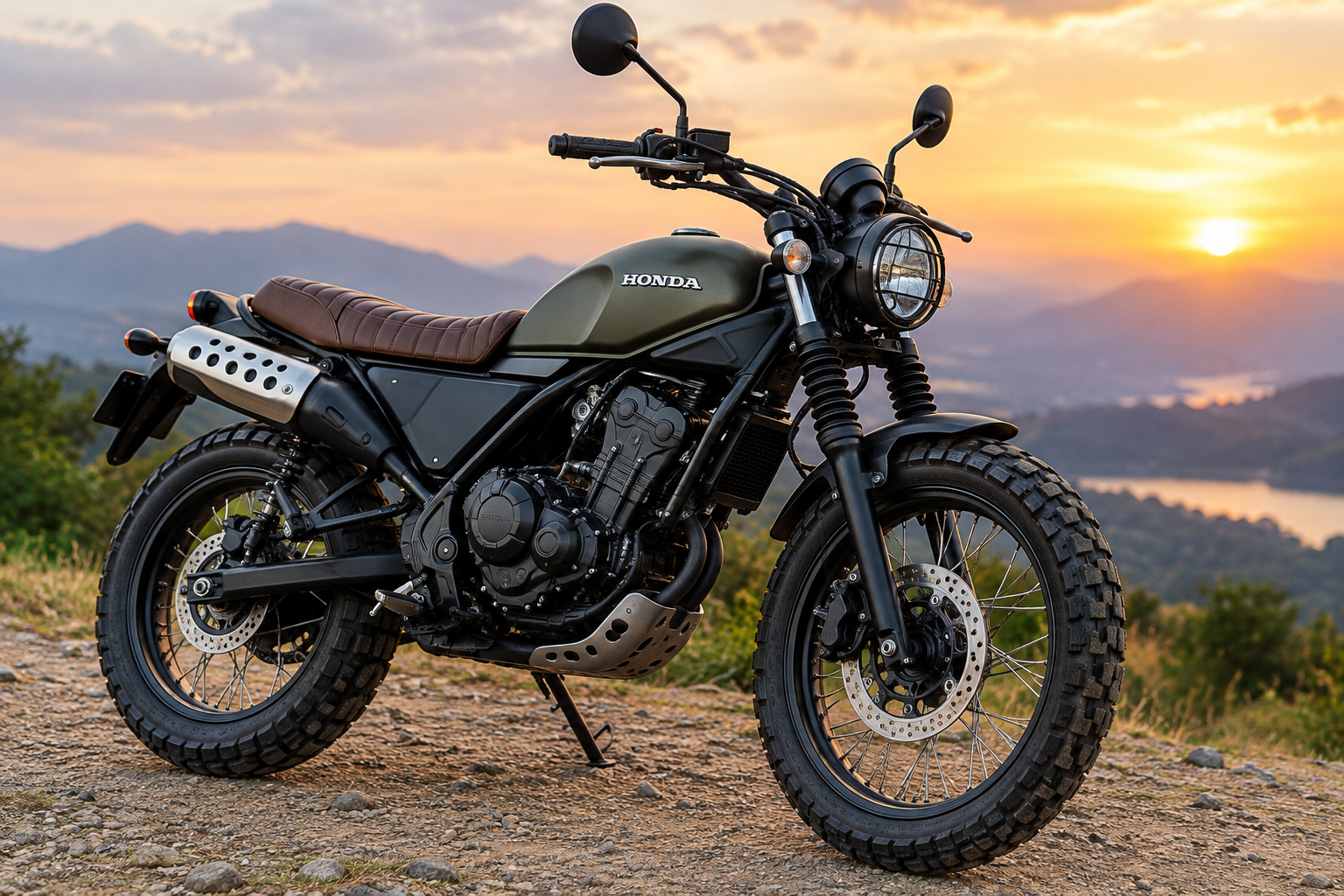
The Honda Scrambler is an appealing choice for riders who want a motorcycle with classic styling, practical performance, and the freedom to explore more than just city streets. Its rugged appearance, upright riding position, high-mounted exhaust, and modern engineering give it a character that feels different from an ordinary commuter bike or a full-sized adventure motorcycle.
When people search for a Honda Scrambler, they are often referring to the Honda CL500, known as the SCL500 in the United States. This modern motorcycle brings back the spirit of Honda’s traditional CL scrambler range while adding contemporary features such as fuel injection, anti-lock braking, and LED lighting.
But good looks are only part of the appeal. A motorcycle also needs to feel comfortable in traffic, deliver power smoothly, handle uneven roads, and remain practical enough for regular use. Here’s a closer look at what the Honda Scrambler offers and what potential buyers should consider before choosing one.
What Is the Honda Scrambler?
The Honda Scrambler is best understood as a motorcycle built around the scrambler style. Unlike a dedicated off-road dirt bike, it combines road-friendly handling with design features inspired by motorcycles that were once adapted for both paved and unpaved routes.
Honda revived its CL scrambler concept with the modern CL500 in 2023. In North America, the closely related model is marketed as the SCL500. Both represent the same general idea: a versatile street motorcycle with a distinctive retro appearance and everyday usability.
The design includes a relatively upright riding position, a broad handlebar, a simple body shape, and an exhaust that sits higher than the exhaust on many conventional street motorcycles. These details give the bike its recognizable scrambler character.
It is important to understand that the Honda Scrambler is not intended to replace a serious motocross bike or a large adventure motorcycle. It is more suited to urban riding, ordinary roads, weekend trips, and occasional light exploration on suitable unpaved surfaces.
For riders who want something stylish without giving up practical road manners, that balance is a major part of its appeal.
Honda Scrambler Design and Styling
One of the strongest reasons riders are attracted to the Honda Scrambler is its appearance. It combines the simplicity of older motorcycles with a more modern finish.
Classic Fuel Tank and Minimalist Bodywork
The fuel tank has a traditional shape that gives the motorcycle a clean, familiar silhouette. Tank pads add to the vintage-inspired appearance while providing a useful contact point for the rider’s knees.
Rather than covering the engine and frame with extensive body panels, Honda leaves much of the mechanical structure visible. The result is a motorcycle that looks purposeful without feeling overly complicated.
This design also makes the bike stand out from many modern motorcycles that rely on sharp bodywork, aggressive graphics, and heavily styled fairings.
High-Mounted Exhaust
The raised exhaust is one of the most recognizable scrambler features. It contributes to the rugged look and gives the Honda CL500 its distinctive profile.
However, a high-mounted exhaust should not be mistaken for proof that the motorcycle is designed for deep water crossings or demanding off-road riding. Riders should still consider the exhaust’s heat, the terrain, and the manufacturer’s intended use before taking the bike away from paved roads.
Wide Handlebars and Upright Ergonomics
The wide handlebars help create a relaxed, upright riding position. This setup offers a clear view of surrounding traffic and can make the motorcycle feel natural during everyday journeys.
The seating position also contributes to the bike’s versatility. Riders can move through city traffic without adopting the crouched posture associated with many sport motorcycles.
Overall, the Honda Scrambler’s styling works because its major design elements serve both a visual and a practical purpose.
Honda Scrambler Engine and Performance
The Honda CL500 and North American SCL500 use a 471cc liquid-cooled, parallel-twin, four-stroke engine. It is paired with a six-speed manual transmission and fuel injection.
This engine size places the motorcycle in the middleweight category. It offers more performance than a small commuter bike while remaining approachable compared with many high-capacity motorcycles.
The engine is designed to provide usable power across everyday riding conditions rather than focusing entirely on extreme acceleration.
Smooth Power Delivery
A motorcycle can have impressive specifications and still feel difficult to ride if its throttle response is abrupt. The Honda Scrambler’s parallel-twin engine is designed to deliver relatively smooth, manageable power, making it suitable for a range of riding situations.
In slow-moving traffic, smooth response helps the rider control speed without constantly making large throttle adjustments. On open roads, the engine provides more flexibility for overtaking and maintaining a comfortable cruising pace.
Honda lists peak torque of approximately 43.4 Nm for the CL500, although published figures and specifications can vary by model year and market.
Six-Speed Transmission
The six-speed gearbox gives riders a useful range of gear ratios for city streets and faster roads. Lower gears help with starting and accelerating, while the higher gears allow more relaxed cruising when road conditions permit.
The clutch is another practical feature. The assist and slipper clutch on the SCL500 helps reduce lever effort and can help manage rear-wheel hop during aggressive downshifts.
For riders who spend a lot of time in traffic, a light clutch can make repeated gear changes less tiring.
Is the Honda Scrambler Fast?
The Honda Scrambler is not primarily a speed-focused motorcycle. Its appeal lies in the combination of accessible performance, comfortable ergonomics, and a distinctive design.
The 471cc engine has enough capacity for everyday commuting and recreational rides, but actual acceleration and top speed depend on factors such as rider weight, road conditions, maintenance, wind resistance, and the specific version of the motorcycle.
Anyone choosing a bike mainly for racing or maximum straight-line speed may prefer a different category. Riders who want a balanced motorcycle for varied everyday use are more likely to appreciate the CL500’s character.
Honda Scrambler Specifications
The following specifications provide a general overview of the Honda CL500 and SCL500. Always confirm the exact details for the model year and country where you intend to buy the motorcycle.
| Specification | Honda CL500 / SCL500 |
|---|---|
| Engine | Liquid-cooled, parallel-twin, four-stroke |
| Engine capacity | 471cc |
| Fuel system | Electronic fuel injection |
| Transmission | Six-speed manual |
| Maximum torque | Approximately 43.4 Nm, depending on version |
| Front wheel | 19-inch |
| Rear wheel | 17-inch |
| Seat height | Approximately 790 mm on the CL500 |
| Fuel tank | Approximately 12 litres |
| Braking system | Disc brakes with ABS |
| Lighting | LED lighting on modern versions |
| Main purpose | Road riding and light scrambler use |
Specifications may differ between regional versions and model years. The table is a general guide rather than a guarantee that every market receives identical equipment.
Riding Comfort and Everyday Usability
A motorcycle can look fantastic in a showroom but become frustrating if it feels uncomfortable after 30 minutes on the road. Fortunately, the Honda Scrambler’s upright ergonomics make everyday comfort an important part of its design.
Comfortable Riding Position
The handlebar position helps the rider sit more upright than on a typical sport bike. This can reduce the need to lean forward and may make short trips and regular commuting feel more relaxed.
The relatively accessible seat height can also help riders feel more confident when stopping at traffic lights or manoeuvring at low speeds.
Comfort is still personal. A rider’s height, leg length, arm reach, and riding experience all influence how the motorcycle feels. A test ride is the best way to find out whether the seat and handlebar position suit your body.
Riding in City Traffic
The Honda Scrambler is suitable for ordinary urban riding, where smooth acceleration, manageable handling, and a clear view of traffic are useful.
Its middleweight engine provides more flexibility than many small-capacity commuter motorcycles, while the upright riding position helps the rider maintain awareness of surrounding vehicles.
The bike is heavier than a basic commuter, however, so it is worth checking how confidently you can move it around a parking space, turn it at walking speed, or manage it on a sloped driveway.
Longer Trips and Highway Riding
The Honda CL500 can also be used for weekend trips and moderate highway journeys. Its engine offers enough flexibility for normal road travel, and its riding position is less aggressive than that of many sport motorcycles.
There is one limitation worth remembering: the bike provides relatively little wind protection. At higher speeds, the rider is exposed to wind, which can become tiring over long distances.
A suitable windscreen, luggage solution, or comfort accessory may help depending on the rider’s needs. However, anyone planning frequent long-distance touring should compare the Honda Scrambler with motorcycles designed specifically for that purpose.
Can the Honda Scrambler Handle Off-Road Riding?
The word scrambler often leads buyers to expect serious off-road ability. The Honda CL500 can handle some light unpaved riding, but its intended use should be understood realistically.
Its 19-inch front wheel, upright controls, and scrambler-inspired design make it suitable for exploring some gravel roads and relatively smooth dirt tracks when conditions are appropriate.
That does not mean it is a dedicated trail motorcycle.
Gravel Roads and Dirt Tracks
On maintained gravel roads, the Honda Scrambler can offer an enjoyable change from ordinary city riding. Riders should reduce speed, avoid sudden braking, and make smooth steering inputs when travelling over loose surfaces.
Tyres make a considerable difference. Standard road-oriented tyres may not provide the same grip as tyres designed for loose dirt, mud, or rocky ground.
Rough Trails and Mud
Deep mud, large rocks, steep technical trails, and deep sand are more demanding. The CL500’s weight and road-oriented setup can become disadvantages in these environments.
Riders should also remember that standard road-bike equipment is not necessarily designed for repeated hard impacts. Suspension travel, ground clearance, tyre choice, and the ability to protect important components all matter when riding off-road.
If serious trail riding is the main goal, a lightweight dual-sport motorcycle or a dedicated adventure model may be a better choice.
The Honda Scrambler makes more sense for riders who spend most of their time on the road but want the freedom to explore easier routes occasionally.
Safety and Braking Features
Modern braking equipment is an important part of the Honda Scrambler’s appeal. The CL500 and SCL500 include anti-lock braking systems, or ABS, which help reduce the risk of wheel lock during hard braking.
ABS is particularly useful when a rider needs to slow down quickly or encounters a surface with less grip than expected. It cannot eliminate every risk, but it provides an additional layer of braking assistance.
The motorcycle also features modern lighting on current versions, improving visibility when riding in different conditions.
Good equipment does not replace safe riding habits. Riders should maintain suitable following distances, use protective gear, keep tyres properly inflated, and adjust their speed to the road surface and weather.
For occasional dirt-road use, it is especially important to avoid assuming that ABS or scrambler styling makes the motorcycle immune to loss of traction.
Honda Scrambler Fuel Economy and Running Costs
Fuel economy is an important consideration when buying a motorcycle, particularly if it will be used for regular commuting.
The Honda CL500’s 471cc engine offers a practical balance between performance and everyday efficiency. However, actual fuel consumption depends on traffic, speed, riding style, tyre pressure, maintenance, and the condition of the motorcycle.
Frequent hard acceleration and sustained high-speed riding generally use more fuel than smooth riding at moderate speeds.
Maintenance
Routine maintenance typically includes checking engine oil, inspecting tyres and brakes, maintaining the chain, and following the service intervals specified in the owner’s manual.
The motorcycle’s liquid-cooled engine also requires the cooling system to be maintained according to Honda’s recommendations.
A used example deserves extra attention. Before buying one, check its service history, mileage, accident damage, signs of corrosion, electrical equipment, and overall mechanical condition.
Spare Parts and Availability
Parts availability can make a major difference to ownership costs. In markets where the CL500 is officially sold, owners may have easier access to authorised service facilities and manufacturer-supported parts.
In countries where the motorcycle is imported, buyers should check local availability before making a purchase. Some components may need to be ordered from overseas, and shipping costs or import duties can increase the final bill.
This is especially important for buyers who depend on their motorcycle for daily transport.
Honda Scrambler Price and Availability
The price of a Honda Scrambler depends on the exact model, model year, location, taxes, import costs, and dealer charges.
The United States-market 2026 Honda SCL500 is listed by Honda with a base MSRP of $6,999, before the destination charge. That figure applies to the US market and should not be treated as the price in other countries.
In markets such as Pakistan, the CL500 may be available through importers or individual sellers rather than a widespread official dealer network. Used prices can vary considerably according to condition, mileage, registration status, and import history.
Before paying a deposit, buyers should confirm the motorcycle’s documentation, chassis and engine numbers, customs status where applicable, and availability of replacement parts.
It is also wise to compare the total ownership cost rather than focusing only on the asking price. Insurance, registration, servicing, fuel, tyres, and protective accessories can add significantly to the initial expense.
Honda Scrambler vs. a Regular Street Motorcycle
The Honda Scrambler and a conventional street motorcycle may share some mechanical features, but they offer different visual styles and riding priorities.
A regular street motorcycle may prioritise straightforward commuting, sporty handling, or everyday value. The scrambler adds a retro-inspired appearance, a high-mounted exhaust, and styling associated with light adventure riding.
Neither category is automatically better. The right choice depends on how and where the motorcycle will be used.
Choose a conventional street motorcycle if your priority is a particular combination of price, commuting convenience, or sporty road performance.
Consider the Honda Scrambler if you want classic styling, an upright riding position, a middleweight engine, and the option of occasional rides on suitable unpaved roads.
Before deciding, compare the seat height, weight, service support, fuel economy, and comfort of the individual models rather than relying on appearance alone.
Who Should Buy a Honda Scrambler?
The Honda Scrambler can suit several types of riders.
Riders who appreciate retro styling: Its simple bodywork, traditional tank shape, and high-mounted exhaust offer a distinctive alternative to sharply styled modern motorcycles.
Commuters who want something more substantial: The 471cc engine provides more performance than a small commuter bike, although the motorcycle’s size and purchase cost may not suit every daily commute.
Weekend riders: The CL500 offers a useful middle ground for relaxed road trips, scenic routes, and occasional light exploration.
Experienced riders seeking an everyday motorcycle: Riders who already own a more specialised machine may appreciate the Honda Scrambler as a practical alternative for shorter journeys and casual rides.
It may be less suitable for buyers who need the lowest possible purchase price, regularly carry heavy luggage over long distances, or expect serious off-road performance.
What to Check Before Buying a Honda Scrambler
Whether you are purchasing a new motorcycle or considering a used one, a little preparation can prevent expensive surprises.
- Confirm the model: Check whether the motorcycle is a CL500, a North American SCL500, or another Honda CL-series model.
- Check the model year: Specifications, equipment, colours, and compliance requirements can vary.
- Take a test ride: Assess the seat height, clutch feel, steering, braking, and overall comfort.
- Inspect the tyres: Look for uneven wear, cracks, damage, and unsuitable tyres for your intended use.
- Review the service history: Confirm that routine servicing has been completed and that any outstanding maintenance is understood.
- Verify the paperwork: Make sure ownership documents and registration details are legitimate and consistent.
- Check local parts support: Ask about the availability and cost of routine service items and important replacement components.
- Calculate the full cost: Include registration, insurance, servicing, protective equipment, and any necessary accessories.
These checks are particularly useful when buying an imported motorcycle, where warranty coverage and after-sales support may differ from those offered in the manufacturer’s main sales markets.
Is the Honda Scrambler Worth Considering?
The Honda Scrambler stands out because it combines old-school motorcycle character with modern mechanical features. The CL500 and SCL500 offer a 471cc parallel-twin engine, six-speed transmission, ABS, and a design that works well for riders who want something more distinctive than an ordinary street bike.
Its greatest strength is versatility for everyday road use. It can handle commuting, relaxed weekend journeys, and suitable light gravel routes without pretending to be a specialised off-road machine.
There are trade-offs. Wind protection is limited, rough trails can be challenging, and ownership costs depend heavily on local availability and service support. Buyers should also remember that the exact specifications and prices vary between markets.
For riders who value classic styling, approachable performance, and everyday usability, the Honda Scrambler is a motorcycle worth a closer look. The best decision comes from matching its real capabilities to your riding habits, budget, and local conditions.
